Lightweight materials for the transportation industry: the role of sandwich panels
Weight reduction has become a key consideration in the design of modern transportation vehicles.
Caricamento tempo di lettura... | 24.07.2026The adoption of new technologies, the growing focus on efficiency and sustainability, and the need to optimise overall vehicle performance have led manufacturers and designers to place increasing emphasis on material selection.
The use of lightweight materials spans a wide range of transportation sectors, including rail, road, marine, aerospace, recreational and special-purpose vehicles. Across all these applications, components are expected to combine low weight, reliability, mechanical strength and compliance with the relevant industry standards.
Among the most widely used technologies are sandwich panels, which are employed in walls, floors, ceilings, doors, partitions and many other structural and interior components. Their versatility allows different panel configurations to be developed according to the specific application and performance requirements. For a detailed overview of sandwich panel construction, materials and their main areas of application, read our article Sandwich panels: what they are and where they are used.
Certifications in the transportation industry
In the transportation sector, material selection is not based solely on mechanical performance. In many applications, materials must also comply with specific fire reaction standards that govern their behaviour in the event of a fire.
For the railway industry, the primary reference standard is EN 45545, which defines the fire protection requirements for materials used in railway vehicles. The standard establishes different performance levels depending on the type of component and the vehicle category, covering applications such as walls, ceilings, floors, doors, linings and many other interior elements.
In the marine sectors, one of the most widely recognised certifications is IMO MED (Marine Equipment Directive). Materials certified to this standard can be used in a wide range od applications on board commercial vessels, ferries and other ships covered by the directive, demonstrating compliance with the required standard for flame spread and fire performance.
Other classifications, such as EN 13501-1, are also used in a variety of industrial and construction applications to classify the fire reaction performance of building materials. The availability of pre-certified sandwich panels provides a significant advantage, allowing designers and manufacturers to select material already qualified or their intended application, helping to simplify the developments process and reduce both time and complexity.
Railway applications

The railway industry is one of the sectors where sandwich panels are most widely used.
Partition walls, ceilings, floors, luggage racks, technical cabinets and numerous interior components require materials that provide rigidity, dimensional stability and compliance with the requirements of EN 45545. The ability to combine different core materials and face sheets makes it possible to develop panel configurations tailored to specific areas of the vehicle, considering both the required performance and the hazard level defined by the standard.
In addition to new rolling stock, sandwich panels are widely used in retrofitting projects, where vehicle interiors are upgraded to extend service life or comply with updated technical and regulatory requirements.
Road transportation
Sandwich panels are widely used in buses, coaches, minibuses, commercial vehicles and special-purpose vehicles for a broad range of interior and exterior applications.
Walls, floors, ceilings, technical compartment covers, partitions and interiors fittings require materials capable of maintaining reliable mechanical performance under continuous loads, vibrations and intensive use.
The ability to customise panel dimensions, thicknesses, face materials and finishes allows manufacturers to adapt each solution to the vehicle’s specific design and intended application.


Marine applications
In the marine industry, sandwich panels are used both in the construction of new vessels and in retrofitting projects. Cabins, bulkheads, flooring, furniture and technical partitions are among the most common applications, where material selection must consider not only mechanical performance but also environmental conditions and applicable regulations.
IMO MED-certifies panel configurations are widely used on commercial vessels, ferries, yachts and other ships covered by the directive, providing designer with materials that already comply with the requirements for a wide range of onboard applications.
The availability of different face materials also makes it possible to develop panes for both technical components and visible interior elements, adapting finishes and characteristics to the spcfici project.
Aerospace applications
Weight reduction has always been a key consideration in the aerospace industry. Sandwich panels are widely used for interior components thanks to their high stiffness-to-weight ratio, allowing lightweight structures to be produced while maintaining the required mechanical performance.
One of the fastest-growing applications is cabin retrofitting. During these projects, interior panels, linings and fittings are replaced with next-generation materials to improve comfort, functionality and overall performance without modifying the aircraft’s primary structure.


Automotive
In the automotive industry, sandwich panels are mainly used in high-performance vehicles, prototypes and specialised applications.
They can be employed for body panels, covers, floor panels and bulkheads, using material such as aluminium, glass fibre or carbon fibre depending on the required performance.
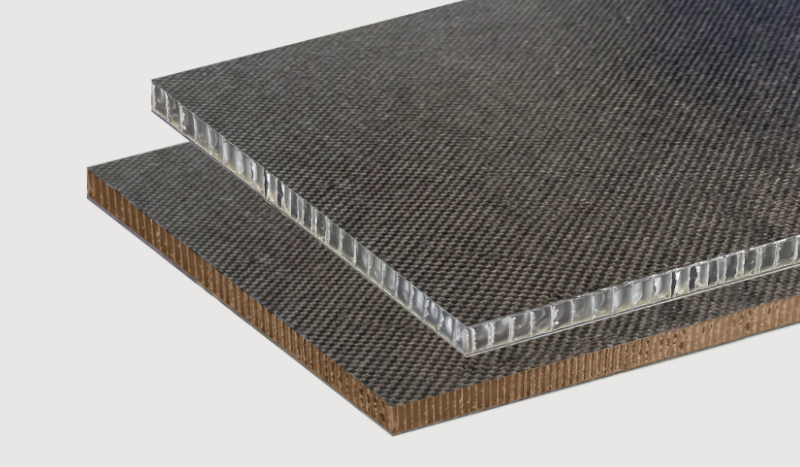
The ability to combine different core materials and face sheets allows panel configurations to be optimised for specific weight, stiffness and strength targets. In applications where minimising weight is a primary design objective, carbon fibre-faced sandwich panels are frequently selected for their outstanding specific mechanical properties. To learn more about these solutions, read our article Carbon fibre sandwich panels: materials, configurations and high-performance applications.
Recreational and Special-Purpose Vehicles
Sandwich panels are widely used in motorhomes, caravans, and a variety of special-purpose vehicles for walls, floors, furniture, and internal partitions.
In these applications, the ability to tailor panel configurations to the specific project, together with dimensional stability and the availability of different face materials, is particularly valuable, allowing components to be integrated into both technical and habitable areas.
The versatility of sandwich panel technology also makes it possible to produce panels in a wide range of shapes, thicknesses, and configurations, a feature especially appreciated in bespoke vehicle fit-outs.

Lightweight materials for the transportation industry: the role of sandwich panels
Weight reduction has become a key focus across multiple transportation sectors, including rail, marine, automotive, and aerospace. At the same time, compliance with industry regulations and the ability to tailor materials to specific applications continue to play a central role in both new vehicle development and retrofitting projects.
Thanks to their combination of lightweight construction, high stiffness, and design flexibility, sandwich panels are used in a wide range of structural and interior components. The availability of different core materials, face sheets, and certified configurations makes it possible to develop solutions for a broad variety of transportation applications, meeting the specific requirements of manufacturers, designers, and vehicle outfitters. In addition to material selection, manufacturing processes, finishing options, and customisation also influence the final performance of the panel and its suitability for a given application. Cutting, CNC machining, bonding, inserts, surface treatments, and finishing options are explored in more detail in our article Sandwich panel processing and finishing.
Our technical team supports the selection of the most suitable material, combining mechanical, manufacturing and regulatory requirements.
Contact us
Related articles

Sandwich panels: what they are and where they are used

Reverberation control in indoor environments: acoustic principles and technical solutions for contemporary architecture
Carbon fibre sandwich panels: materials, configurations and high-performance applications
Resources & Contacts
Looking for more information or technical advice on the most suitable panel for your project?