Carbon fibre sandwich panels: materials, configurations and high-performance applications
In the world of advanced composite materials, carbon fibre sandwich panels represent one of the most effective solutions for the design of lightweight structures with outstanding mechanical performance.
Caricamento tempo di lettura... | 10.06.2026Originally developed to meet the demanding requirements of the aerospace industry, these materials are now used across a wide range of sectors where weight reduction, high stiffness and structural stability are critical. Motorsport, marine, rail, aerospace and technical design are just some of the industries where carbon fibre sandwich panels are used to reduce structural weight without compromising performance.
The construction principle is simple yet highly effective: two thin carbon fibre skins are separated by a lightweight core, typically aluminium honeycomb or Nomex®. This configuration makes it possible to achieve exceptionally stiff and lightweight structures, making sandwich panels particularly suitable for high-performance applications.
To learn more about the construction principles and main applications of sandwich panel technology, read our dedicated article on sandwich panels.
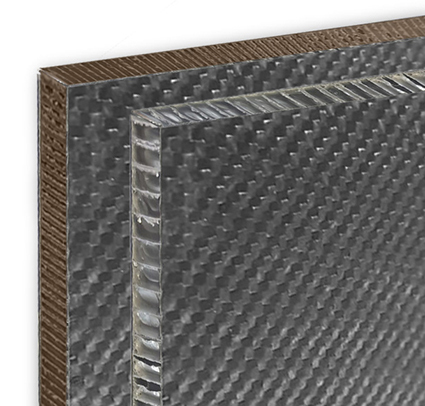
Carbon fibre skins
The outer skins are the load-bearing element of the panel and are responsible for most of its mechanical performance.
The properties of the skins depend on factors such as fabric weight, weave pattern, filament count and fibre orientation.
Fabric weight and fibre configuration
The most commonly used fabric weights for structural sandwich panels typically range from 93 to 600 g/m². For aerospace and motorsport components, fabrics between 100 and 200 g/m² are frequently used, while marine and industrial applications may require higher surface weights.
Another important parameter is the number of filaments contained within each fibre tow. A 1K fabric is made from tows containing approximately 1,000 filaments, while a 3K fabric contains around 3,000 filaments per tow. The choice between different configurations depends on the requirements of the project and influences both the characteristics of the fabric and the final appearance of the surface, which may exhibit a finer or more pronounced weave pattern.
Weave patterns and laminate construction
TAmong the most common weave patterns is plain weave, characterised by a regular interlacing structure that provides excellent dimensional stability, good processability and a uniform surface finish. This configuration is widely used for sandwich panels intended for technical and structural applications.Another widely used option is twill weave, recognisable by its distinctive diagonal pattern. Twill fabrics offer improved drapability and provide the characteristic appearance commonly associated with carbon fibre components in the automotive and motorsport industries.
For specific structural requirements, unidirectional and multiaxial fabrics may also be employed. These materials are designed to concentrate strength and stiffness along the principal load paths. Depending on the required performance, multiple layers of carbon fibre can be combined and oriented in different directions to optimise the laminate's mechanical behaviour and increase stiffness and strength in highly stressed areas.
From a mechanical perspective, carbon fibres exhibit a significantly higher modulus of elasticity than many metallic materials of comparable weight. This property makes it possible to produce extremely stiff components with reduced mass, contributing to improved performance, energy efficiency and handling characteristics in the systems where they are used.
Mechanical performance of carbon fibre sandwich panels
The use of carbon fibre makes it possible to manufacture panels that are exceptionally lightweight while maintaining high levels of stiffness and strength. This combination of properties is particularly advantageous in applications where weight reduction contributes to improved performance, lower energy consumption, faster operating speeds or increased payload capacity.
In addition to their outstanding stiffness-to-weight ratio, these panels offer:
- high flexural strength
- excellent compressive strength
- outstanding dimensional stability
- excellent fatigue resistance
- low thermal expansion
- high corrosion resistance.
The combination of these characteristics enables the design of lightweight yet highly efficient structures capable of withstanding both dynamic and cyclic loading conditions.
Aluminium honeycomb or Nomex®: which core should you choose?

The performance of a carbon fibre sandwich panel depends not only on the outer skins, but also on the type of core material used. Among the most common solutions for high-performance applications are aluminium honeycomb and Nomex® honeycomb, each offering specific advantages depending on the requirements of the project.
Aluminium honeycomb
Aluminium honeycomb is one of the most widely used core materials in structural sandwich panels thanks to its combination of low weight, high stiffness and compressive strength. These properties make it particularly suitable for marine, rail and motorsport applications, as well as for any project where weight reduction must be achieved without compromising structural integrity.Configurations combining carbon fibre skins with an aluminium honeycomb core represent a proven solution for lightweight, high-performance components, providing an effective balance of stiffness, reliability and reduced weight.

Nomex®
Nomex®, a honeycomb material manufactured from aramid paper impregnated with phenolic resin, is used in applications where minimising weight is a key design requirement. At the same thickness, it enables the production of extremely lightweight structures while maintaining good mechanical properties and providing both thermal and electrical insulation.
Thanks to these characteristics, Nomex is widely used in the aerospace industry for interior panels, bulkheads, radomes and secondary aircraft structures. Configurations combining Nomex cores with carbon fibre skins are a well-established solution for high-performance applications where optimising the weight-to-performance ratio is a primary design objective.
The choice between aluminium honeycomb and Nomex does not depend on the existence of a universally superior solution, but rather on the specific requirements of the project, the desired weight savings and the performance targets of the final component.
Industrial applications
Thanks to their exceptional stiffness-to-weight ratio, carbon fibre sandwich panels are used wherever weight reduction delivers benefits in terms of performance, efficiency and energy consumption.
In motorsport and high-performance marine applications, they help reduce structural weight while maintaining high levels of stiffness. In the aerospace sector, they contribute to lowering the overall weight of aircraft and technical components. These same characteristics are also highly beneficial for drones and UAV systems, where reduced weight can increase flight endurance and payload capacity.
Carbon fibre sandwich panels are also increasingly used in retrofitting projects, allowing conventional components to be replaced with lighter alternatives while maintaining the required structural strength and dimensional stability.

Thanks to their combination of low weight, high stiffness and excellent mechanical performance, these materials continue to gain ground across a growing number of technical applications, establishing themselves as a benchmark technology for lightweight structural design.
Related articles

How sandwich panels drive innovation

Case history: corporate signage made with Compocel AL panels

Reverberation control in indoor environments: acoustic principles and technical solutions for contemporary architecture
Resources & Contacts
Looking for more information or technical advice on the most suitable panel for your project?