PET, PVC and PMI Foams: Properties and applications
Structural foams such as PET, PVC and PMI are widely used engineering materials in the design of lightweight, high-performance components
Caricamento tempo di lettura... | 01.04.2026Structural foams such as PET, PVC and PMI are widely used engineering materials in the design of lightweight, high-performance components. Their application spans multiple industries, from transportation and construction to more advanced sectors, where weight optimisation and mechanical performance are key design drivers.
These materials, mostly used as foam cores for composites or cores for sandwich panels, feature a closed-cell structure that enables an effective balance between weight reduction, stiffness and mechanical strength. However, their use is not limited to sandwich panels: PET, PVC and PMI foams are also employed as lightweight structural elements or support cores in complex technical components.
Structural foam properties and mechanical behaviour

Engineering foams for composite applications are designed to actively contribute to the overall performance of the system. They play a role in load distribution, dimensional stability and resistance to mechanical stress.
One of the key parameters in foam selection is density, which directly affects properties such as:
- compressive strength
- shear strength
- stiffness
- resistance to localised loads
Higher densities generally result in improved mechanical performance, while lower densities allow for greater weight reduction. This makes PET, PVC and PMI foams particularly suitable for applications where optimising the strength-to-weight ratio is essential.
PET foam: versatility, processability and sustainability
PET foam (polyethylene terephthalate) is one of the most widely used structural foams for composite and sandwich panel applications, thanks to its versatility and balanced combination of mechanical performance and processability.
Typical density ranges span from approximately 60 to 250 kg/m³, allowing the material to be tailored to different load conditions. Lower densities are used in lightweight applications, while higher densities provide increased mechanical strength and improved resistance to localised loads.
At higher densities, the material can also support direct mechanical fastening, without the need for inserts, due to the increased compactness of its cellular structure.
PET is used across a wide range of sectors, including construction, transportation and industrial applications, both as a core material for sandwich panels and as a lightweight structural component. The possibility of incorporating recycled content is also a relevant advantage in projects with sustainability requirements.
PVC foam: proven performance and reliability
PVC foam (polyvinyl chloride) is a well-established solution among structural core materials for composites. Its long-standing use across industries has resulted in a well-defined and predictable performance profile.
Available densities typically range from approximately 50 to 200 kg/m³, making PVC suitable for a broad spectrum of applications. It offers good compressive and shear properties, along with stable performance over time, even under repeated loading conditions.
This consistency makes PVC foam particularly suitable for structural and semi-structural applications where reliability and predictable behaviour are required.
PVC foam is widely used in marine applications, renewable energy (such as wind turbine blades), transportation and various industrial sectors, where it represents a proven and dependable technical solution.
PMI foam: high-performance core material
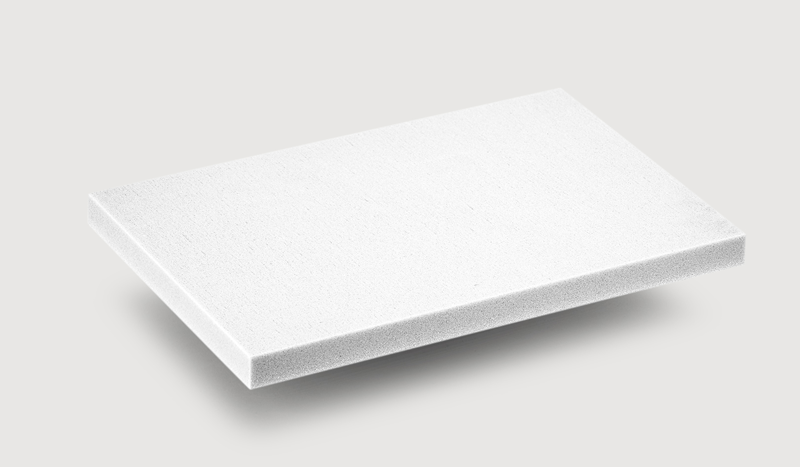
PMI foam (polymethacrylimide) is typically selected for applications where mechanical performance and thermal stability are critical.
Density ranges generally fall between 30 and 200 kg/m³, and even at lower densities, PMI delivers high specific stiffness. This allows for excellent mechanical performance while maintaining low weight—an essential requirement in high-performance sectors.
PMI also offers high thermal stability, with continuous service temperatures typically up to 180 °C and, in certain grades, up to approximately 250 °C. This makes it suitable for manufacturing processes involving elevated thermal cycles, including autoclave processing.
As a result, PMI is widely used in aerospace, motorsport and advanced engineering applications, where material performance directly impacts the final behaviour of the component.
Applications of PET, PVC and PMI foams
Structural foams used as cores in sandwich panels are applied across a wide range of industries, thanks to their ability to adapt to different design requirements.
In the transportation sector, they are used to reduce component weight and improve overall efficiency. In marine applications, they contribute to the development of lightweight and mechanically efficient structures, while in construction they are used in building systems and technical panels.
They are also used in industrial applications for machinery and technical components, as well as in high-performance sectors where weight reduction and mechanical response are key factors.
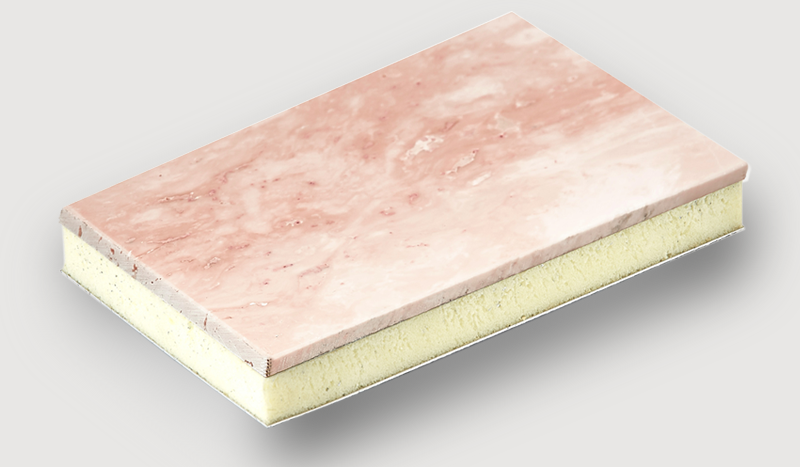
An increasingly relevant application area is the lightweighting of natural stone, where foams are used as core materials in sandwich panels bonded to stone slabs. This approach significantly reduces weight while preserving the aesthetic and surface properties of the material, expanding its use in architecture, interior design and the marine sector.
To learn more:

Foam selection as part of the design process
Selecting between PET, PVC and PMI foams cannot be reduced to a simple comparison. Material selection depends on a combination of design factors that must be evaluated as a whole.
Key considerations include:
- operating conditions
- mechanical loads
- weight targets
- manufacturing processes
- regulatory requirements
Density is also a critical parameter, as it directly affects both the material behaviour and the performance of the final component. For this reason, foam selection should be approached as an integral part of the design process, considering the interaction between all elements within the system.
Explore our structural foam solutions
CEL Components develops and supplies PET, PVC and PMI foam solutions for sandwich panels and composite applications, selected according to specific project requirements.
Discover more:
You can also explore our dedicated article:
Sandwich panels: what they are and where they are used
Our technical team supports material selection and design development, aligning mechanical, manufacturing and regulatory requirements.
Contact us
Related articles

Marble lightweighting: how sandwich panels make stone lighter
PMI Foam: properties, behaviour and selection criteria in advanced composites
Petstep: PET foam sandwich panel for lightweight stone and marine applications
Resources & Contacts
Looking for more information or technical advice on the most suitable panel for your project?